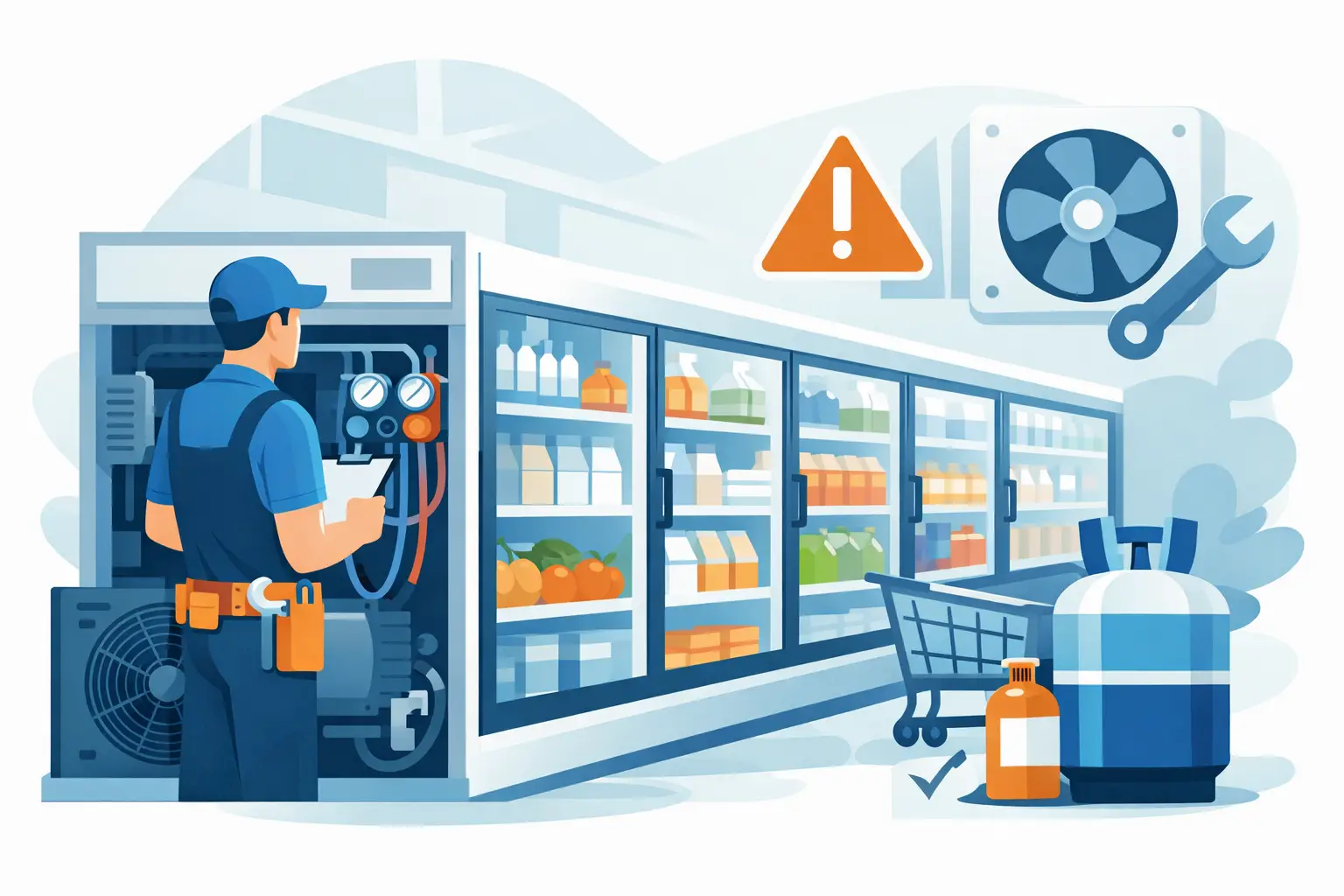
A failing cabinet rarely gives you much warning. One pack of soft dairy, a strip of condensation on a glass door, or a freezer case that seems slightly louder than usual can be the first sign that a larger problem is building. In supermarkets, refrigeration is not a background system. It protects stock, supports food safety, controls energy spend and keeps the shop floor trading. That is why supermarket refrigeration maintenance needs to be planned, not left until a breakdown forces the issue.
For store managers, facilities teams and owners, the real challenge is not simply keeping equipment running. It is keeping a mixed estate of display cabinets, walk-in cold rooms, freezer rooms, condensers and controls working consistently under heavy daily use. The right maintenance approach reduces emergency callouts, extends equipment life and helps avoid the sort of temperature drift that quietly damages margin before anyone spots it.
Why supermarket refrigeration maintenance matters
In a supermarket environment, refrigeration works hard for long hours with frequent door openings, changing load levels and constant demand from customers and staff. That operating pattern creates wear in places that are easy to miss during routine store checks. Door seals flatten, coils gather dust, evaporators ice up, fans slow down and refrigerant issues can develop gradually rather than all at once.
The cost of ignoring these early faults is rarely limited to one repair bill. A poorly performing system can raise electricity use, shorten compressor life and put chilled or frozen stock at risk. In some cases, the biggest losses come from repeated minor faults that never quite stop trading but steadily reduce performance.
There is also the compliance side. Temperature control is not just a technical target. It sits directly alongside food safety, product quality and audit readiness. If refrigeration temperatures are inconsistent, the operational knock-on effect can move quickly from maintenance to waste, customer complaints and lost sales.
What a good maintenance plan should cover
A proper maintenance plan should reflect the equipment you actually have on site and how heavily it is used. A small convenience store and a large supermarket will not need the same service intervals, and older systems often require more attention than newer, well-installed plant.
At minimum, maintenance should cover the core mechanical and electrical components, system controls, airflow, cleanliness and temperature accuracy. That means checking compressors, condensers, evaporators, fan motors, drain lines, defrost systems, wiring, sensors and controller settings. It also means looking at how the system is operating as a whole, not just whether it is technically still running.
This is where experience matters. A competent engineer does not just tick through a list. They notice when a cabinet is working harder than it should, when a condensing unit is cycling oddly, or when an air leak is creating a problem that will return until the underlying cause is dealt with.
Cabinets, cold rooms and freezer rooms need different attention
Not all supermarket refrigeration assets fail in the same way. Open multideck cabinets are more exposed to store conditions and customer traffic, so airflow and temperature stability are often the first concerns. Integral units can suffer from dust build-up and poor ventilation around the condenser. Walk-in cold rooms and freezer rooms may have stronger plant, but door traffic, damaged seals and ice formation can create persistent inefficiency.
A maintenance schedule should account for those differences. Treating every unit as if it has the same duty and risk profile usually means some equipment is over-serviced while other critical assets are not checked often enough.
The warning signs you should not ignore
Some refrigeration faults are dramatic. Many are not. The early signs are usually operational rather than catastrophic, which is why they are often missed during a busy trading day.
If a cabinet is struggling to pull down to set temperature, if products feel inconsistent across shelves, or if glass doors are misting more than usual, something is worth investigating. Likewise, unusual noise, increased icing, water around the unit, longer run times and unexplained energy spikes all point to a system under strain.
It also pays to watch staff behaviour. If team members start avoiding a certain cabinet because it “never seems quite right”, that is useful information. The same applies if products are being moved around to compensate for warm spots. In practice, frontline staff often spot changes before a formal inspection does.
Preventive maintenance versus reactive repair
Reactive repair has its place. Even well-maintained systems can fail unexpectedly, and rapid response is essential when they do. But relying on breakdown support alone is an expensive way to manage supermarket refrigeration.
Preventive maintenance gives you a chance to correct faults while they are still small. Cleaning coils before head pressure rises, replacing worn door gaskets before moisture ingress worsens, or recalibrating controls before temperatures drift will nearly always cost less than waiting for compressor damage or major stock loss.
That said, the balance depends on the age and condition of the site. If a store is running older equipment near the end of its service life, maintenance may need to be combined with a realistic replacement plan. Throwing repeated repairs at unreliable assets is not always the best commercial decision. Sometimes the right answer is targeted upgrade work that improves reliability and lowers energy use at the same time.
Energy performance is part of maintenance
Supermarket refrigeration is one of the largest energy loads in most food retail environments, so maintenance is closely tied to running costs. A system can stay operational while becoming steadily less efficient, and that inefficiency often goes unnoticed until bills rise or a major component fails.
Dirty condensers, poor airflow, refrigerant leaks, failing evaporator fans and incorrect control settings all force equipment to work harder. Even simple issues, such as damaged night blinds or doors not closing properly, can have a measurable impact over time.
Good maintenance should therefore look beyond fault prevention. It should also ask whether the system is operating efficiently for the current use of the store. Seasonal changes, layout alterations and shifts in stock profile can all affect refrigeration performance. A practical engineering partner will take those conditions into account rather than servicing the plant in isolation.
What supermarket managers can do between engineer visits
Planned maintenance visits are essential, but day-to-day site checks still matter. Store teams do not need to diagnose plant faults, but they can help catch obvious issues early.
Basic housekeeping makes a real difference. Keeping units clear of packaging debris, reporting damaged door seals quickly, checking that vents are not blocked and making sure stock is not overpacked all support stable airflow and temperature control. Recording recurring issues properly also helps engineers trace faults faster when they attend.
The key is consistency. If checks only happen after a complaint or failed temperature reading, preventable problems can sit for weeks. A simple routine, followed properly, usually delivers better results than an overcomplicated process no one has time to maintain.
Choosing the right maintenance partner
For supermarkets, refrigeration support needs to be responsive and practical. You need engineers who understand the commercial impact of downtime and can work across display refrigeration, cold rooms, freezer rooms and associated plant without passing responsibility between multiple contractors.
That is especially important when faults cross over between installation quality, controls, airflow and plant condition. A provider with end-to-end capability can usually resolve issues faster because they are looking at the full system rather than one isolated component.
It also helps to work with a company that is clear about service intervals, reporting and follow-up. Maintenance should not feel vague. You should know what has been checked, what needs attention now, what can wait, and where future risk sits. That kind of visibility makes budgeting easier and reduces the chance of unpleasant surprises.
For businesses that cannot afford prolonged downtime, access to emergency support matters as much as planned servicing. The strongest maintenance arrangements combine both – regular preventive work to reduce faults, backed by rapid technical response when something unexpected happens. That is the standard businesses across London and the wider UK increasingly expect from specialist providers such as UK Cold Room.
Supermarket refrigeration maintenance works best when it is proactive
The most effective supermarket refrigeration maintenance is not about chasing perfection. It is about reducing avoidable risk, keeping temperatures stable and making sensible decisions before small faults become costly ones. Every supermarket site has its own pressures, from customer traffic and store layout to ageing equipment and rising energy costs, so the right plan should fit the reality of the operation.
If your refrigeration is critical to daily trading, maintenance is not an overhead to delay until next quarter. It is part of protecting stock, controlling cost and keeping the business moving when the rest of the day is already busy enough.