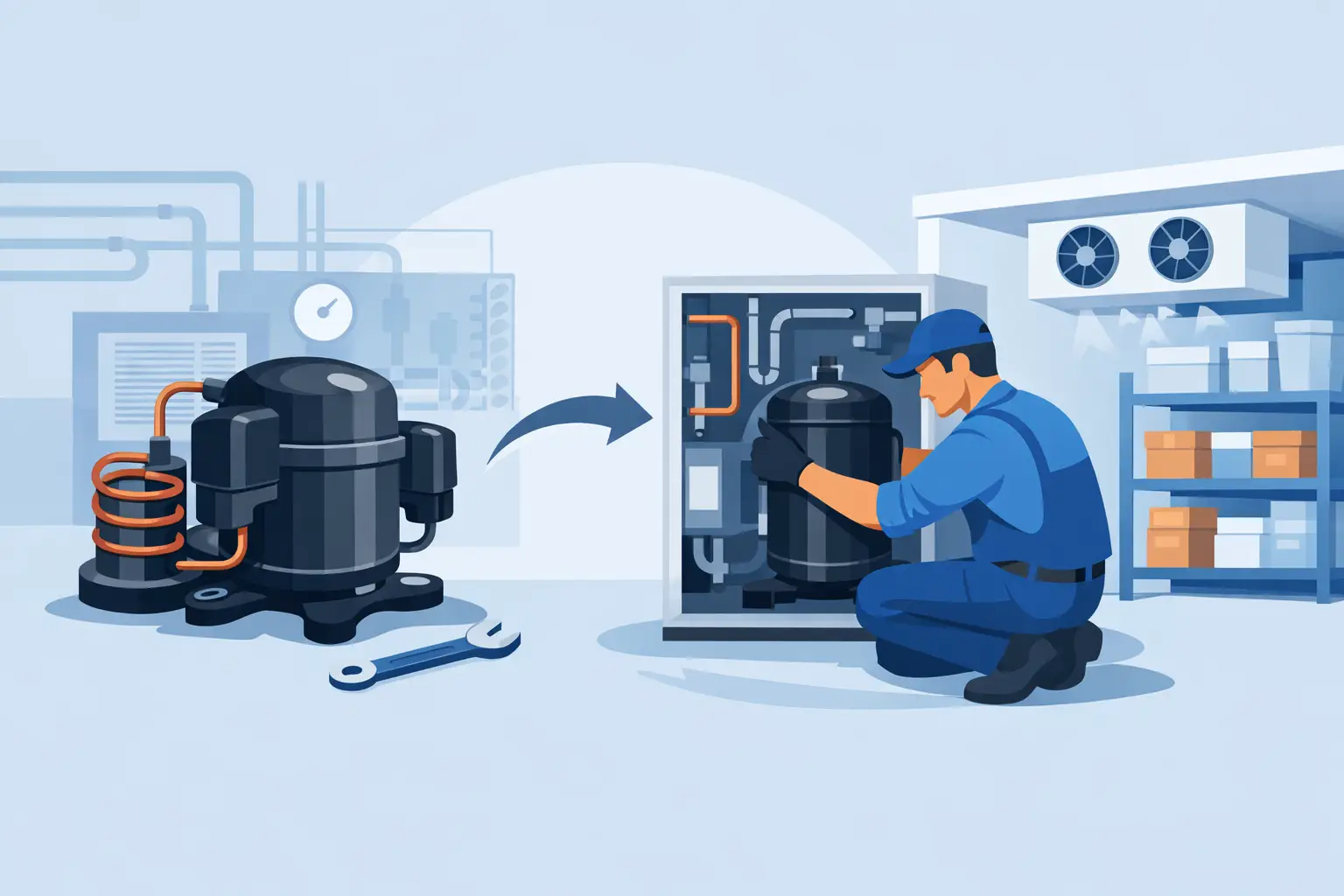
When a cold room starts struggling to hold temperature, the compressor is usually the first component everyone worries about – and for good reason. It is the heart of the refrigeration system. If it fails, stock is at risk, energy use climbs, and downtime can quickly turn into a costly operational problem. Compressor replacement for cold room systems is not just a repair job. It is a decision that affects reliability, running costs, and how long the whole system will continue to serve your business.
For restaurants, supermarkets, wholesalers and pharmaceutical storage sites, that decision needs to be made quickly but not blindly. Replacing a compressor too early wastes money. Leaving a failing one in place can lead to a full breakdown, product loss, and emergency callout costs. The right approach starts with proper diagnosis.
When compressor replacement for cold room equipment is the right call
Not every cooling fault points to a failed compressor. Poor temperature pull-down can also come from refrigerant leaks, dirty condensers, blocked evaporators, failed fan motors, expansion valve issues, or electrical faults. A good engineer will check the full system before recommending replacement.
That said, there are some common signs that a compressor is reaching the end of its life. Repeated tripping, hard starting, overheating, excessive noise, burnt windings, and loss of compression are all serious warnings. If the unit is drawing abnormal current or short cycling under normal load, the problem may be internal rather than external.
Age matters too. If the compressor is already several years into heavy commercial use and has a history of breakdowns, replacement often makes more sense than another temporary repair. On older systems, especially where parts are becoming harder to source, a like-for-like swap may be the most practical route to stabilise the site.
Repair or replace – what actually makes sense?
This is where experience matters. A compressor can sometimes be saved if the issue sits around the edges – for example, a failed capacitor, contactor, overload, crankcase heater, or control fault. These are straightforward repairs compared with replacing the full compressor assembly.
But if the compressor has suffered internal mechanical damage or electrical burnout, repair is rarely the sensible option. Once debris and acid contamination are present in the refrigeration circuit, the job becomes more than changing one part. The system may need flushing, filter drier changes, oil management checks, refrigerant replacement, and close commissioning to avoid damaging the new compressor.
The decision usually comes down to five practical questions: how old the system is, whether the failure is internal, the availability of compatible parts, the cost of downtime, and whether the rest of the plant is still in good order. A business storing high-value stock may choose replacement sooner simply to reduce risk. A site with an ageing system and poor efficiency may be better looking at a wider upgrade instead of replacing one major part.
What causes a cold room compressor to fail?
Compressor failure is often the final symptom, not the original fault. That distinction matters because fitting a new compressor without correcting the root cause can lead to another failure not long after.
One common cause is poor airflow across the condenser. When condensers are blocked with dirt or grease, head pressure rises and the compressor runs hotter and harder than it should. Low refrigerant charge can also be damaging, especially if it causes poor cooling of the motor windings or unstable system operation. Liquid floodback is another major issue. If liquid refrigerant returns to the compressor instead of vapour, internal parts can be damaged quickly.
Electrical supply problems should never be overlooked. Phase imbalance, voltage drop, failed relays and poor connections all place stress on the motor. On busy commercial sites, lack of maintenance is often behind repeat compressor problems. The compressor gets blamed because it is the part that stops, but the real issue may have been developing for months elsewhere in the system.
What happens during compressor replacement for cold room systems?
A proper replacement is a controlled engineering job, not a quick swap. First, the system must be tested to confirm the diagnosis and check whether any contamination is present. The refrigerant is recovered safely, the failed compressor is removed, and the replacement unit is matched correctly to system capacity, refrigerant type, operating conditions, and electrical requirements.
The pipework and controls then need careful attention. If the old compressor has burnt out internally, the engineer may need to clean the system, replace driers, and inspect expansion components before commissioning the new unit. Oil type and quantity must be correct. Vacuum testing, pressure testing and leak checks are essential before recharging and restarting.
This stage is where shortcuts become expensive. A poorly matched compressor or weak commissioning process can leave the cold room running, but not reliably. Temperatures may drift, energy bills may rise, and the new compressor may fail earlier than expected.
Downtime, stock protection and planning around operations
For most commercial customers, the biggest concern is not the compressor itself. It is what happens to the stock while the repair is carried out. Timing matters, especially for frozen storage, high-turnover catering operations, and pharmaceutical environments with strict temperature records.
In some cases, replacement can be planned around quieter trading periods or completed with temporary stock relocation. In others, the job needs to be carried out urgently to prevent a full outage. The more critical the stored goods, the more valuable fast diagnosis becomes. Acting when the compressor is failing, rather than after it has stopped altogether, usually gives more options.
This is one reason many businesses prefer to work with one refrigeration partner that can diagnose, repair, replace and maintain the full cold room system. It reduces delay and avoids the common problem of one contractor blaming another.
How much does compressor replacement cost?
There is no single figure that suits every cold room. Cost depends on compressor type, refrigerant, system size, site access, labour time, and whether there is wider damage in the circuit. A small integral cold room condensing unit is a different job entirely from a larger remote system serving a freezer room or multi-room storage area.
The cheapest quote is not always the cheapest outcome. If the new compressor is undersized, incompatible, or installed without addressing contamination, repeat failure can cost far more than doing the job properly the first time. On the other hand, full system replacement is not always necessary. If the cold room panels, evaporator, controls and pipework are still sound, replacing the compressor can extend useful system life at a sensible cost.
A reliable contractor should explain the options clearly: immediate repair if viable, compressor replacement if justified, or wider plant replacement if the system no longer offers value.
Choosing the right contractor for compressor replacement for cold room work
This is specialist work. Commercial refrigeration systems need more than general electrical knowledge or basic HVAC experience. The contractor should understand refrigeration load, refrigerant compatibility, compressor selection, superheat and subcooling, contamination control, and the practical demands of live business environments.
It also helps to choose a team that can support the system after the repair. A new compressor fitted into a neglected system is still a neglected system. Ongoing maintenance, condenser cleaning, electrical checks and performance monitoring all help protect that investment.
For businesses that rely on uninterrupted chilled or frozen storage, response time matters as much as technical skill. If a contractor can attend quickly, diagnose properly, and carry out the work with minimal disruption, that has a direct value beyond the invoice. UK Cold Room supports commercial sites with repair, replacement and ongoing maintenance for exactly that reason.
Preventing the next compressor failure
No compressor lasts forever, but most premature failures are preventable. Regular servicing gives engineers the chance to spot high discharge temperatures, poor airflow, refrigerant issues and worn electrical components before they develop into a major breakdown.
It also gives site managers a clearer picture of the condition of the whole system. If energy use is creeping up or temperature recovery is slowing down, those signs can be investigated early. Planned intervention is always easier to manage than an emergency failure on a busy trading day.
If your cold room compressor is showing signs of distress, the best next step is not guessing – it is getting the system assessed properly. Sometimes the answer is a straightforward repair. Sometimes compressor replacement is the sensible route. What matters is making that call based on the real condition of the system, the value of the stock you are protecting, and the cost of getting it wrong.