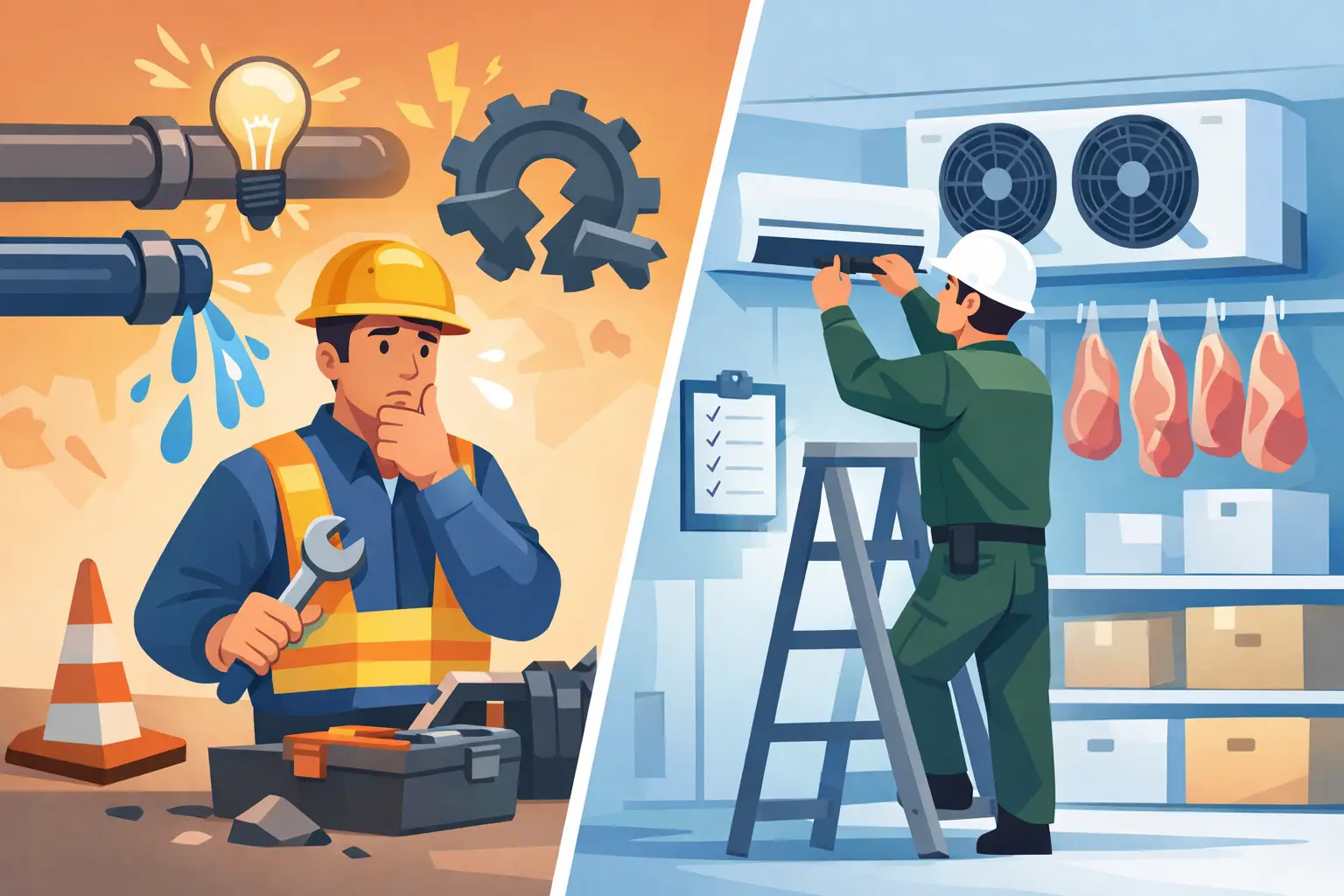
A cold room rarely fails at a convenient time. It goes down during a lunch rush, overnight with a full stockholding inside, or just before a delivery is due out. That is why the question of reactive repairs or planned maintenance matters so much for businesses relying on chilled or frozen storage. It is not just an engineering choice. It affects stock loss, compliance, energy use, staffing pressure and how much disruption your operation can absorb.
For many sites, the real answer is not choosing one and ignoring the other. You need emergency repair support when something unexpected happens, but relying on breakdowns as your main maintenance strategy is where costs start to build quietly in the background.
Reactive repairs or planned maintenance – what is the difference?
Reactive repairs mean you call an engineer when something has already gone wrong. That could be a failed compressor, an evaporator icing up, rising room temperature, a refrigerant leak, faulty controls, damaged door seals or a unit that simply stops running. The benefit is obvious – you only pay when there is a visible problem.
Planned maintenance is different. It involves scheduled inspections, servicing and performance checks designed to catch wear, contamination and inefficiencies before they become a breakdown. In a commercial refrigeration setting, that usually includes checking refrigerant pressures, electrical components, coils, condensers, drains, fan motors, door closers, seals, control settings and general system performance.
On paper, reactive repairs can look cheaper. In practice, that depends on what a failure costs your business once downtime, wasted stock, emergency attendance and lost trading time are taken into account.
Why reactive repairs often cost more than they first appear
If your cold room is not mission-critical, a reactive approach may sometimes be workable. But for most food businesses, wholesalers and pharmaceutical sites, the hidden cost is the real issue.
A breakdown rarely affects just one component. A dirty condenser left unchecked can force the system to run hotter and longer. That strain can shorten compressor life. A worn door seal can increase temperature fluctuation and energy consumption for months before anyone notices. A blocked drain can lead to ice build-up, airflow problems and eventually larger faults.
By the time you are calling for an urgent repair, the original issue may have already caused secondary damage. The invoice then reflects more than a single failed part.
There is also the operational pressure. Staff end up moving stock, checking temperatures manually, dealing with rejected deliveries or explaining delays to customers. If the room stores high-value or regulated goods, the risk increases quickly. One period of temperature loss can create far more financial damage than a routine service visit ever would.
That does not mean reactive repairs are avoidable in every case. Even well-maintained systems can fail unexpectedly. Electrical faults, component defects and end-of-life failures still happen. The point is that emergency response should be your safety net, not your whole strategy.
When planned maintenance makes the biggest difference
Planned maintenance is most valuable where downtime is expensive, stock is sensitive or equipment runs hard for long periods. That includes restaurant cold rooms, supermarket freezer rooms, production storage, distribution hubs and pharmaceutical environments where temperature control is non-negotiable.
In these settings, the benefit is not only fewer breakdowns. It is more predictable performance. Engineers can spot parts nearing failure, identify systems running inefficiently and correct small faults before they affect product temperature. That helps businesses budget more accurately and avoid repeated emergency callouts.
There is an energy case as well. Refrigeration systems lose efficiency gradually. Condenser fouling, poor airflow, incorrect charge levels, failing fan motors and damaged insulation do not always trigger an immediate breakdown, but they do increase running costs. A system can remain operational while still costing you more every month.
Planned maintenance gives you visibility. Instead of waiting for a major issue, you can make informed decisions about repair versus replacement, timing works around operations and extending equipment life where it is sensible to do so.
The trade-off – upfront cost versus long-term control
Some businesses resist maintenance contracts because they see them as an extra fixed cost. That concern is understandable, especially for smaller operators managing tight margins. If equipment seems to be working, paying for preventative service can feel like spending money on a problem you do not yet have.
But refrigeration does not normally fail without warning. It deteriorates. The challenge is that those warning signs are often technical rather than obvious. Higher amp draw, pressure imbalance, frost patterns, inconsistent defrost cycles or compressor short cycling are not things most site teams will spot during a busy shift.
That is where planned maintenance earns its place. You are not paying for unnecessary work. You are paying for inspection, testing and practical engineering judgement before a fault turns into an urgent business risk.
Still, it depends on the site. A single small cold room with low-value stock and backup capacity may justify a lighter-touch approach. A large freezer room serving multiple operations almost certainly will not. The right decision comes down to criticality, stock value, compliance requirements and how much downtime your business can realistically tolerate.
How to decide what your business actually needs
A useful question is not simply, “Can we manage reactive repairs?” It is, “What happens if this room is out of action for six hours, twelve hours or a full day?”
If the answer involves lost stock, interrupted service, missed dispatches, food safety risk or damaged customer confidence, then planned maintenance is not really optional. It is part of protecting the business.
You should also look at asset age and usage. Older systems usually need closer attention, particularly if they have already had repeated faults. Equipment working in hot kitchens, busy loading areas or high-door-traffic environments tends to wear faster than systems in more stable conditions. The harder the room works, the less sense it makes to adopt a wait-until-it-breaks approach.
Another factor is access to support. If you do rely partly on reactive service, response time matters. Fast attendance can reduce stock risk, but only if the provider has the right refrigeration knowledge and parts access to diagnose problems properly. Temporary fixes that get the room running for a day or two are sometimes necessary, but they should not become the norm.
A balanced approach usually works best
For most commercial refrigeration users, the strongest model is planned maintenance backed by responsive emergency repair. That gives you the best of both. You reduce avoidable failures through routine servicing, while still having a route to fast support when something unexpected happens.
This is especially useful for businesses running cold rooms and freezer rooms year-round. Maintenance can be scheduled around trading patterns, identified defects can be dealt with in a controlled way, and urgent issues can still be prioritised when they arise. It is a practical approach rather than an idealistic one.
A good maintenance partner should also be honest about what can be prevented and what cannot. Not every failure is foreseeable. What matters is reducing the frequency of avoidable breakdowns, improving system efficiency and making sure repairs are done properly rather than repeatedly.
For businesses with multiple assets, this joined-up approach becomes even more valuable. Patterns start to emerge across sites or systems. Recurring faults can be investigated at root cause level, not just patched over. That is where maintenance moves beyond servicing and starts contributing to long-term cost control.
What planned maintenance should include
Not all maintenance is equal. A proper visit should involve more than a quick visual check and a service sheet. Commercial refrigeration needs hands-on inspection of mechanical, electrical and control elements, plus attention to the room itself.
That means looking at how the entire system is performing – not just whether it is currently cold. Coil condition, airflow, door condition, drain function, defrost operation, compressor health, control calibration and refrigerant performance all matter. In many cases, the issue behind high energy use or poor temperature recovery sits in the details.
If your provider only appears when there is a breakdown, you miss that broader view. A company with installation, repair and maintenance experience can usually give more practical advice because they understand how the system was built, how it is being used and where it is likely to fail first.
The better question is not which one – it is how much risk you can carry
Reactive repairs have their place. No business can eliminate unexpected faults altogether, and emergency support is essential when refrigeration fails. But if you are choosing reactive repairs or planned maintenance as though they carry the same level of business risk, they do not.
One waits for disruption and pays the price after the event. The other gives you more control over uptime, costs and equipment condition. For cold storage environments where failure can affect safety, compliance and revenue within hours, that difference is hard to ignore.
If your cold room is central to daily operations, maintenance is less about servicing a unit and more about protecting the business behind it. That is usually the point where a reactive mindset stops looking economical.
The most sensible plan is the one that matches the real cost of downtime, not just the cost of the engineer’s visit.