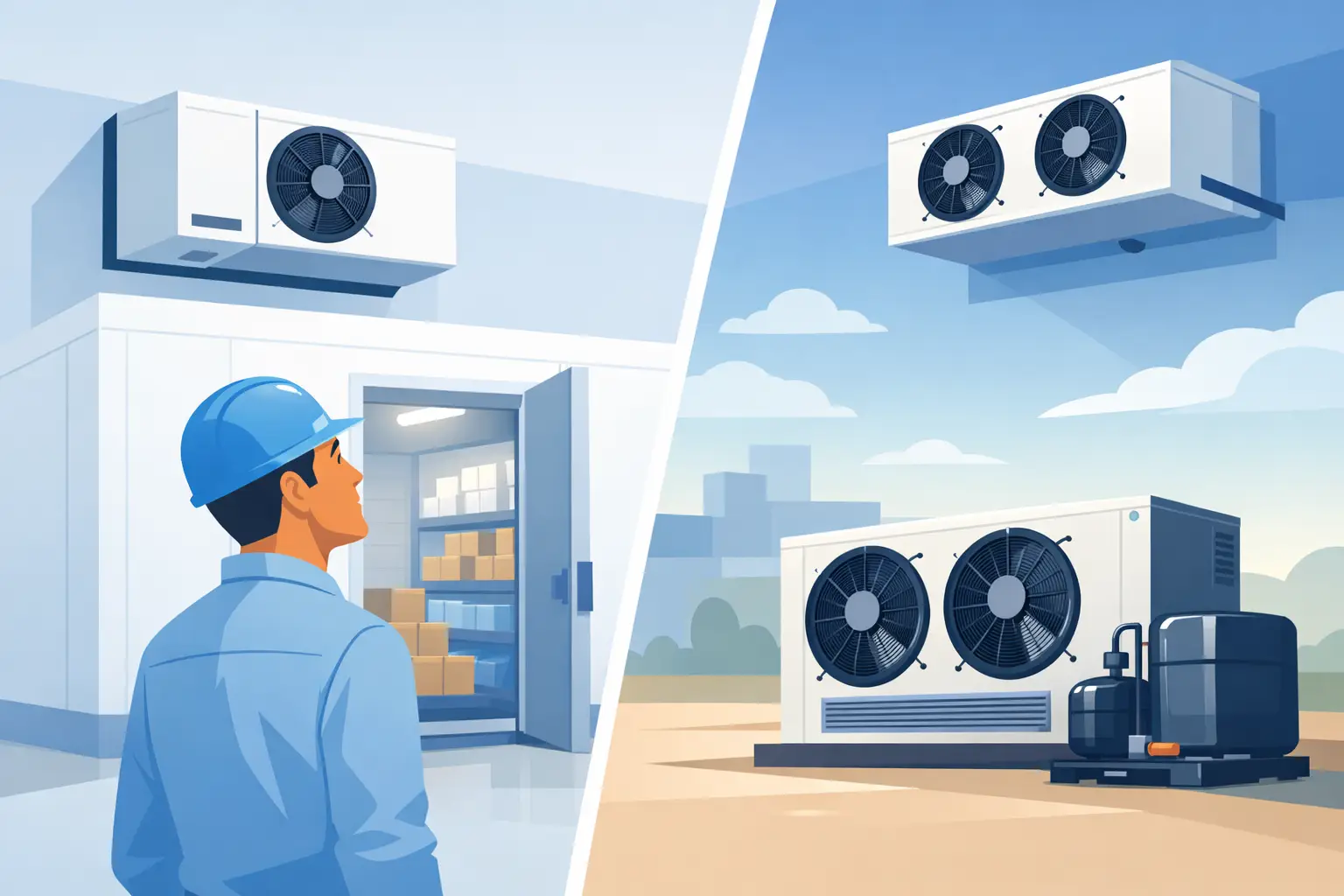
A cold room that looks fine on paper can still become a daily headache if the condensing unit is wrong for the site. When clients ask us about monoblock or remote condensing units, they are usually not asking for theory. They want to know what will keep stock safe, energy bills sensible, and breakdown risk under control.
That is the right question to ask early. The condensing unit has a direct effect on room performance, available space, noise levels, heat rejection, service access and long-term running costs. For restaurants, supermarkets, wholesalers and pharmaceutical environments, this is not a minor design choice. It can shape how reliable the whole cold room is over the next several years.
Monoblock or remote condensing units: what is the difference?
A monoblock condensing unit is a packaged system fitted directly to the cold room structure, usually through a wall or ceiling panel. The evaporator and condensing section are built together in one factory-assembled unit. Installation is generally quicker because much of the refrigeration circuit is already contained within the package.
A remote condensing unit separates the condensing section from the evaporator inside the room. The evaporator sits in the cold room, while the condensing unit is installed elsewhere, often outside or in a plant area, and connected by refrigeration pipework and controls.
On the surface, the decision can look simple. Monoblocks are compact and convenient. Remote systems offer more flexibility. In practice, the right answer depends on how the room is used, where it is located, and what matters most to the business operating it.
When a monoblock unit makes sense
Monoblock systems suit sites that need a straightforward installation and do not have the space, budget or layout to justify a more involved plant arrangement. Smaller walk-in chillers and freezers often work well with this setup, especially in foodservice environments where speed of installation matters.
Because the unit is factory assembled, there is less site work involved. That can reduce installation time and limit disruption, which is useful in working kitchens, retail back-of-house areas and smaller commercial premises. There are also fewer separate components to coordinate during the install.
For some operators, that simplicity is the biggest advantage. If you are fitting out a modest cold room and need a practical system without overcomplicating the project, a monoblock can be a very sensible choice.
There are limits, though. Monoblock units reject heat close to the room itself unless carefully positioned. In a tight kitchen or service area, that extra heat load may create problems elsewhere. Noise can also be more noticeable because the condensing section is not relocated away from occupied areas. Service access is another point to consider. If the unit is mounted in a difficult position, routine maintenance can become awkward.
When remote condensing units are the better option
Remote systems are often the better fit for larger cold rooms, more demanding temperature requirements, or sites where internal heat and noise need to be kept down. By moving the condensing unit away from the cold room, you can improve working conditions around the storage area and manage heat rejection more effectively.
This matters in busy commercial kitchens, food production areas and temperature-sensitive facilities. If staff are working near the cold room all day, reducing background noise and excess ambient heat can make a real operational difference. In some buildings, it is not just a comfort issue. It can affect compliance, airflow planning and the performance of surrounding equipment.
Remote systems also give more freedom in system design. Where pipe runs, plant space and access are properly planned, they can support better performance across larger capacities and more complex installations. For businesses expecting growth, or for sites where uptime is critical, that flexibility is often worth the additional installation work.
The trade-off is that remote systems are more involved to install correctly. Pipework design, refrigerant charge, controls, insulation, drainage and commissioning all need proper attention. A poor installation will cause problems later, even if the equipment itself is good.
Cost is not just the purchase price
A lot of buyers focus first on upfront cost, which is understandable. Monoblock units often look more attractive at that stage because they are quicker to fit and involve less site labour. If the application is simple and the environment suits the unit, that can be the right commercial decision.
But capital cost only tells part of the story. Over time, energy efficiency, maintenance access, component lifespan and the effect of heat rejection on the wider building all start to matter. A cheaper installation can become more expensive if it leads to higher running costs or difficult servicing.
Remote systems typically cost more to install, but in the right application they may offer better long-term value. If the unit location helps it run in better ambient conditions, or if engineers can access it more easily for maintenance and repairs, that can reduce downtime and improve service life.
There is no honest one-size-fits-all answer here. The better question is which option gives the best value over the working life of the cold room, not just on day one.
Noise, heat and site layout often decide the answer
Internal heat gain
Every refrigeration system has to reject heat somewhere. With a monoblock unit, that heat is much closer to the room itself. In a compact back-of-house space, this can increase ambient temperatures and place extra strain on ventilation or air conditioning.
With a remote system, the condensing unit can usually be positioned where heat rejection is less of a problem. That can support more stable surrounding conditions and reduce unwanted heat build-up inside the building.
Noise in working areas
Noise is easy to underestimate during planning and hard to ignore once the system is live. In kitchens, prep areas and retail spaces, equipment noise adds up quickly. A monoblock may be perfectly acceptable in one setting and disruptive in another.
Remote condensing units generally help where quieter internal conditions are needed, because the noisier part of the system is located away from the occupied area.
Practical access
Maintenance should never be an afterthought. If access panels cannot be reached safely, or if service work interrupts trading every time, the system is not properly planned. A well-positioned remote condensing unit can make inspection, cleaning and repair more straightforward. That matters when a fault needs quick attention.
Performance depends on installation quality
Whichever route you choose, the equipment alone will not guarantee reliable results. Correct sizing, proper airflow, accurate controls, suitable refrigerant selection and clean commissioning all matter. We regularly see systems underperform because the installation was rushed or the application was not assessed properly from the start.
A monoblock fitted to the wrong room can short cycle, struggle in high ambient conditions or create avoidable nuisance for staff. A remote system with poor pipework design can lose efficiency, suffer from oil return issues or become unreliable under load. Neither option is forgiving if corners are cut.
That is why site assessment matters. Room size, target temperature, door usage, stock load, building ventilation and available service access all need to be looked at together. The best answer comes from matching the system to the reality of the site, not from choosing whatever seems easiest at quotation stage.
Which option suits your business?
If you run a smaller restaurant cold room, a compact retail walk-in, or a straightforward chilled store where quick installation and lower initial cost are the priority, a monoblock may be the right fit. It keeps the project simpler and can perform very well when the room and surrounding environment suit it.
If you manage a larger cold store, a high-use freezer room, or a site where noise, internal heat and serviceability are major concerns, remote condensing units often make more sense. They ask for more planning up front, but that extra work can pay back in efficiency, access and operational stability.
For pharmaceutical storage and other compliance-led environments, remote systems are frequently preferred because control, access and environmental management tend to carry more weight than installation simplicity. That said, there are cases where a well-chosen monoblock still works perfectly well. It depends on the risk profile of the site and how demanding the application is.
A reliable refrigeration system starts with getting the basics right. If you are weighing up monoblock or remote condensing units, the smartest move is to assess the room, the building and the day-to-day demands before settling on a specification. The right choice is the one that keeps your operation steady when the room is full, the doors are busy, and failure is not an option.