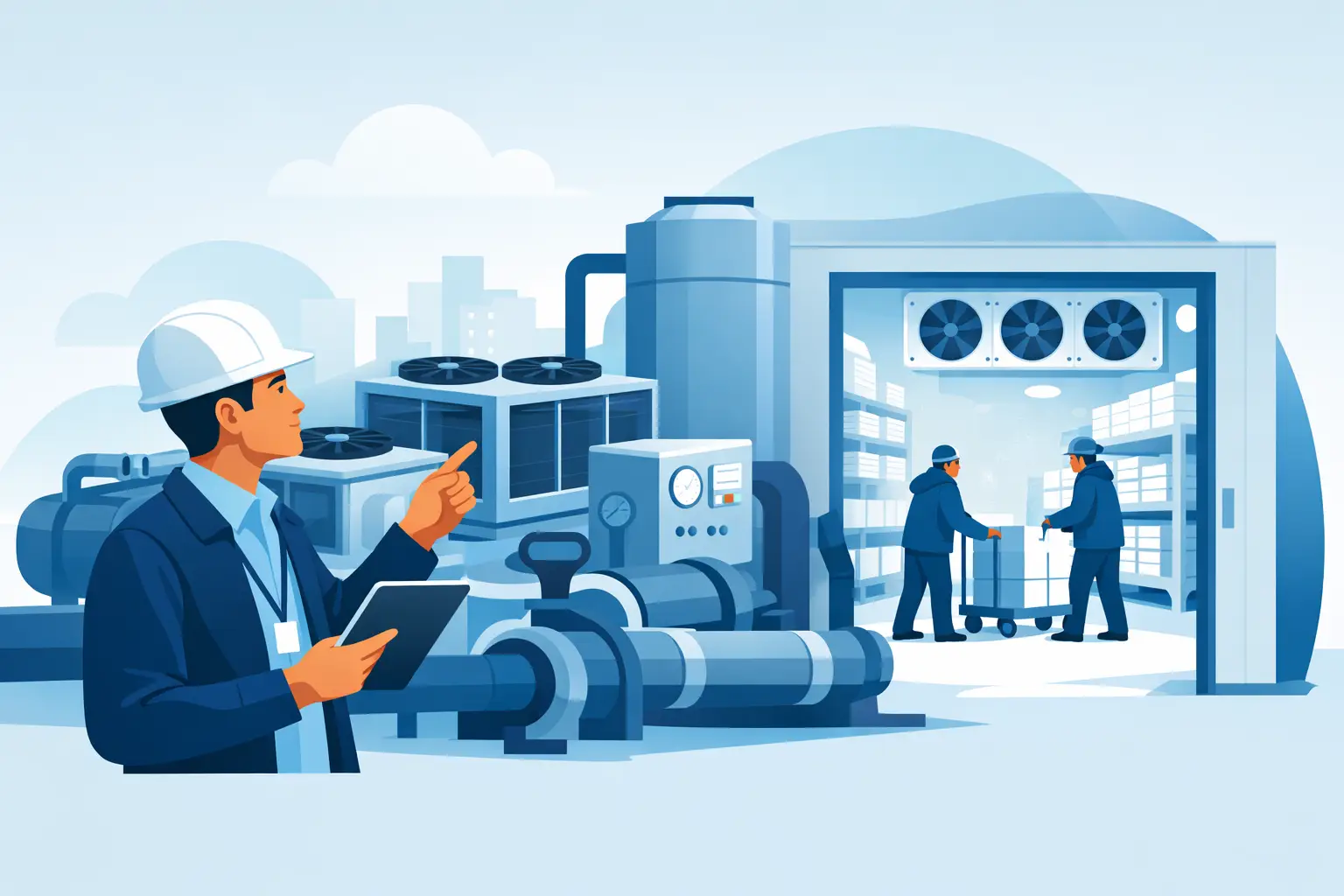
If your cold room keeps temperature but your energy bills keep climbing, that is usually the first warning sign. For many operators, a commercial cooling system retrofit becomes necessary long before total failure. The issue is not always that the plant has stopped working. More often, it is working harder than it should, costing more than it should, and leaving less room for error than your business can afford.
That matters whether you run a restaurant, a supermarket, a pharmaceutical store or a wholesale facility. In these environments, cooling is not a background utility. It protects stock, supports compliance and keeps daily operations moving. Waiting until a major breakdown forces a decision is usually the most expensive route.
What a commercial cooling system retrofit actually means
A retrofit is not the same as a full replacement. In most cases, it means upgrading the key parts of an existing cooling system so it performs better, runs more efficiently and suits current operational demands. That could involve replacing ageing condensing units, upgrading controls, changing evaporators, improving insulation around the cold space, or reconfiguring pipework and airflow.
Sometimes the goal is energy reduction. Sometimes it is reliability. Sometimes the system no longer matches the way the site now operates. A freezer room designed for one delivery cycle may struggle if stock turns have increased, doors are opened more often, or ambient conditions around the plant have changed.
The right retrofit depends on what is causing the problem. This is why proper assessment matters. Swapping one component without understanding the wider system can create a new set of issues, especially in commercial refrigeration where each part affects pressures, temperatures and overall load.
The signs your system is due for retrofit work
Most businesses do not need an engineer to tell them when a system feels wrong. They notice it in higher running costs, more frequent callouts, uneven temperatures or staff complaints about warm spots and excessive icing.
If breakdowns are becoming more frequent, that is an obvious trigger. But there are quieter warning signs too. Compressors running for longer cycles, condensers fouling up repeatedly, old controls failing to hold a stable set point, or fan motors struggling under continuous demand can all point towards a system that is ageing out of efficient service.
In some cases, the plant still has life left in it, but the control strategy is outdated. Older systems often run in a blunt, energy-hungry way because they were installed to meet basic cooling demand, not to optimise performance. A retrofit can bring in better monitoring, staged operation and tighter temperature control without ripping out the entire installation.
You may also face external pressure. Refrigeration regulations, refrigerant availability and rising electricity costs all affect long-term running costs. If you are already spending heavily to keep an old system going, keeping it as it is may no longer be the cheaper option.
Why replacement is not always the best first move
There are cases where full replacement is the right answer. If the plant is badly sized, structurally poor, repeatedly leaking or built around obsolete equipment that cannot be supported properly, replacement may save time and money over the medium term.
But many systems do not need that level of intervention. A well-planned commercial cooling system retrofit can deal with the weak points while preserving the usable parts of the installation. That reduces disruption, helps control capital spend and can often be scheduled around operational hours more easily than a full rebuild.
This is particularly useful on live sites where downtime carries a direct business cost. Restaurants cannot simply stop service for a week. Supermarkets cannot leave chilled stock unprotected while major works drag on. In pharmaceutical settings, the margin for temperature risk is even tighter. Retrofitting can often be phased to keep exposure lower.
The trade-off is that retrofits need careful engineering judgement. If too much of the old system is left in place without checking compatibility, you can end up with an upgraded plant that still underperforms because the root issue was never solved.
Where the biggest gains usually come from
Energy efficiency gets most of the attention, and for good reason. Older refrigeration systems often consume far more power than they need to. Worn compressors, inefficient condensers, poor evaporator performance and outdated controls all push electricity use up.
However, the biggest gain is not always a dramatic cut in kilowatt hours. For many businesses, it is improved stability. Better temperature control means less product risk. More reliable defrost cycles mean less ice build-up and less strain on the system. Smarter controls can reduce unnecessary run time and help plant operate in a more balanced way throughout the day.
Airflow is another area that gets overlooked. If the evaporator arrangement or fan performance no longer suits the room layout, some sections of the cold space can overwork while others stay marginal. A retrofit that improves air distribution can make the whole room more consistent, which matters for both food safety and stock quality.
Insulation and door condition should also be part of the conversation. There is little point fitting better refrigeration equipment if cold air is being lost through damaged panels, poor seals or doors that are slow to close. Good retrofit planning looks at the room as a working system, not just the machinery attached to it.
Planning a retrofit without disrupting the site
The practical question most operators ask is simple: can this be done without shutting us down? The answer depends on the type of system, the condition of the existing plant and how much resilience your site already has.
In many cases, yes, at least partially. Works can often be phased, temporary cooling can sometimes be arranged, and some upgrades can be completed outside peak operating hours. What makes the difference is planning. A proper survey should identify not just the technical solution but also the operational risk, access constraints and the best sequence of works.
This is where experience matters. On a busy site, retrofit work is not just about refrigeration knowledge. It is about understanding stock movement, staffing patterns, hygiene rules, noise limitations and how much downtime the business can realistically absorb. The best result is one that improves the plant without creating fresh operational problems.
For businesses in London and other high-demand locations, logistics can make planning even more important. Access windows, delivery timing and site coordination often affect the programme as much as the engineering itself.
Cost, payback and the mistake of judging on price alone
Retrofit costs vary widely because system sizes, room conditions and operating loads vary widely. A small cold room with control upgrades is very different from a large multi-zone facility needing compressor, condenser and evaporator changes.
What matters is not just the installation cost but the cost of doing nothing. If your system is pulling excessive power, causing repeated stock concerns or generating regular emergency repairs, those costs are already eating into the business. A cheaper short-term repair can become expensive if it simply delays the real fix by six months.
Payback is usually strongest where equipment is clearly inefficient or oversized, where electricity use is high, or where reliability problems are creating direct revenue loss. For some sites, the return is obvious on energy and maintenance savings alone. For others, the stronger value is in reduced risk and better operational confidence.
That is why honest advice matters. Not every system needs a major retrofit, and not every upgrade pays back quickly. A dependable engineering partner should tell you where retrofit work will make a measurable difference and where a repair or planned replacement would be more sensible.
Choosing the right partner for retrofit work
A commercial cooling retrofit should not be treated as a parts swap. It needs a provider that understands design, installation, fault diagnosis and aftercare, because each stage affects the next. If the survey is weak, the specification will be weak. If the installation is rushed, the system may never perform as intended.
Look for practical experience with live commercial sites, not just catalogue recommendations. You need clear communication, realistic programming and support after the work is complete. Commissioning, testing and follow-up matter just as much as the hardware.
For businesses that depend on uninterrupted cold storage, the right retrofit is not about chasing the newest kit for its own sake. It is about getting a system that fits the load, controls costs and gives you confidence when the site is under pressure. If your current plant is becoming harder to trust, that is usually the point to act – before it decides the timing for you.